Boulder, Colorado · Boulder County
Frameless Sliding Glass Enclosures for Pergolas in Boulder
Your pergola. A place to stay awhile.
A slow morning with coffee. An unhurried dinner with friends. Make more of the space under your pergola with frameless sliding glass — open for fresh air on pleasant days, closed to help shelter you from wind, rain and blowing snow.
Custom-Fabricated in Colorado · European Components · 5-Year Product & Installation Warranty
Weather protection for suitable covered spaces — not an insulated room addition.
Made for the way you use your pergola
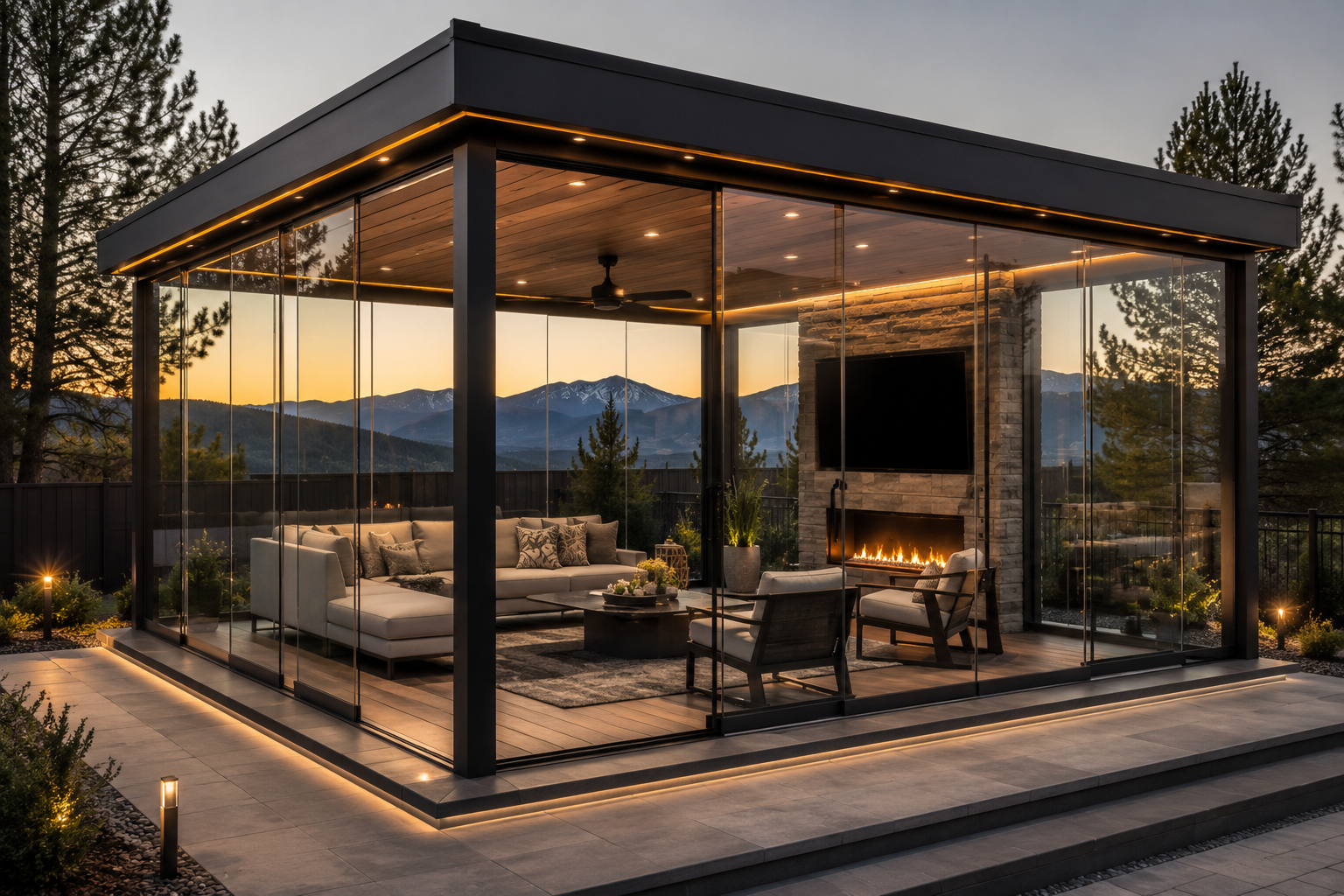
Glass Project custom-fabricates and installs frameless sliding glass enclosures for suitable new and existing pergolas in Boulder.
We plan the glass around your seating, the route to your garden and the openings you want to use most often. The aim is a more sheltered place to spend time, with sliding panels that let you adjust how open the space feels.
Not sure this is the right product? Read how pergolas & gazebos work statewide.
European Engineering. Custom Fabrication in Colorado.
We source aluminum profiles and hardware from Europe, then custom-fabricate each enclosure here in Colorado. We cut, mill and powder-coat the profiles, order glass to your project’s exact dimensions, and assemble and install the finished system. Your glazing is made to fit your space — not the other way around.
Planned for your structure and Boulder exposure
Adding glass changes how wind acts on a pergola. At the on-site survey, we review the posts, base connections, supporting surface and roof frame, then confirm what further structural assessment the project needs. Any reinforcement or engineering scope is discussed before the glazing is ordered.
Our sliding panels roll on the bottom track while the upper track guides them. The lower support must carry the panel weight, and both tracks and their fixings must suit the opening and the project’s structural requirements. The system is not suspended from the pergola roof.
Each panel moves along its own track line and overlaps with the others at one or both sides, depending on the layout. We confirm the stacking area, clear passage and access to your garden during design, and explain operation and care at handover.
Reference: National Weather Service — Denver/Boulder forecast office
Boulder's heavy spring snow is a roof question
Our glass encloses the vertical sides; it does not replace the pergola roof. An open-slat roof still lets rain and snow into the space. We discuss your roof, drainage and the shelter you want before choosing a glazing layout, rather than assuming glass sides alone make the space dry.
If that roof is marginal, deal with it before glazing. It is straightforward to replace a roof panel over an open pergola and considerably less pleasant over a finished glass run. Whatever structure carries the enclosure also has to be assessed against the design loads your jurisdiction assigns to your site; we work to those figures and can provide manufacturer documentation for the system on request. We do not publish our own snow or wind ratings.
Reference: National Weather Service — Denver/Boulder forecast office · NOAA NCEI — U.S. Climate Normals
Sun, shade and an opening that works for you
Think about when you use your pergola and where the afternoon sun falls. Shade, ventilation and the panel layout work together; glass sides alone do not guarantee cooler summer temperatures or prevent furniture from fading.
The panels slide and stack within the opening, so ventilation can be adjusted as conditions allow. Where solar control or UV protection matters, ask about compatible glass options and their documented performance before the specification is final.
How a Boulder pergola enclosure installation runs
First, a free on-site survey in Boulder: we measure the openings and review the supporting surface, posts, roof and fixings. Then we plan the panel count, opening direction and stacking area around your furniture, garden access and the way you want to use the pergola.
Third, a written quote recording the glazing scope and any reinforcement identified during the survey; if site-specific discoveries or jurisdiction requirements arise later, they are handled explicitly rather than folded in quietly. On approval, a signed agreement and a 50% deposit start fabrication: typical lead time is 45 business days after the signed agreement and deposit, with the final schedule confirmed for your project and any required City of Boulder review completed before the affected work.
Profiles are cut, milled and powder-coated in Colorado, glass is ordered to the confirmed dimensions, and the system is assembled for installation. At handover, we show you how to open, stack and care for the panels.
City of Boulder permitting
The City of Boulder publishes its building permit process and a residential permit guide setting out when a permit is required and what a submittal must contain. Whether your pergola enclosure needs one depends on the structure, what it is attached to, and what the work changes.
Confirm applicability with the city for your address before scheduling. We build to whatever the review requires and supply the documentation the process asks for — we will not tell you a permit is unnecessary.
Reference: City of Boulder — building permits and inspections · City of Boulder — residential building permit guide
See photographs of completed Colorado installations or read who installs them.
Free Estimate
Request your free on-site estimate in Boulder
Pergolas & Gazebos in Boulder — questions we get
Will an enclosed pergola survive a Boulder windstorm?
Wind suitability is assessed for the specific address, supporting structure, panel sizes and fixings. We review the site and provide available system documentation for the project review. Any required reinforcement or engineering is addressed before installation; we do not promise that every existing pergola is suitable without assessment.
Does the glass replace my pergola roof?
No. The system encloses the vertical perimeter. Your existing roof stays and still carries the snow, which is why we ask about its condition before quoting.
Is heavy spring snow a problem for the enclosure?
Roof snow loads and windblown snow need to be considered separately. The roof and supporting frame are reviewed against the project requirements; vertical glazing is not a replacement roof. An open-slat pergola can still receive snow from above.
Does Boulder require a permit for this?
It depends on your structure and scope. The City of Boulder publishes its permit process and a residential permit guide — confirm applicability for your address before work is scheduled.
Do you build the pergola itself, or only enclose it?
Our primary service is frameless sliding and stacking glass for suitable new and existing pergolas and gazebos. If pergola construction or structural work is needed, we can discuss the scope and coordinate it with our licensed builder partner; it is not automatically included with every glazing project.
Will this turn my pergola into an insulated room?
No. This is single-glazed weather protection, not an insulated room addition. Closed panels help reduce wind and blowing precipitation, but the system is not completely airtight or watertight and does not guarantee an indoor temperature.
What warranty comes with the enclosure?
We provide a 5-Year Product & Installation Warranty. The exact coverage and terms are set out in your written quote before you commit.
Pergolas & Gazebos elsewhere
Other services in Boulder
Most useful next