Boulder, Colorado · Boulder County
Pool Enclosures in Boulder
A Boulder pool enclosure lives or dies on ventilation
Boulder's swimming season is short, and enclosing the pool is the obvious way to extend it. The part most owners have not thought about is what happens to the air inside once you do. Warm water in a closed space raises humidity fast, and Boulder's dry outside air stops being the thing that carries that moisture away.
So the first half of a pool enclosure conversation here is not about glass. It is about how the space breathes, where condensation will land, and what that means for hardware and for whatever the enclosure is attached to.
Not sure this is the right product? Read how pool enclosures work statewide.
Why enclosing helps at this elevation
Evaporation is the largest heat loss path for an outdoor heated pool, and Boulder's combination of dry air, altitude and wind makes it worse than the raw temperature suggests. Reducing air movement across the water surface reduces that loss, which is the physical reason an enclosure lowers heating demand.
We do not publish a saving percentage. It depends on your pool volume, set temperature, cover use, how often the enclosure is opened and how it is ventilated — and any installer quoting you a fixed number without those inputs is inventing it.
Reference: National Weather Service — Denver/Boulder forecast office · NOAA NCEI — U.S. Climate Normals
Ventilation and hardware are the specification
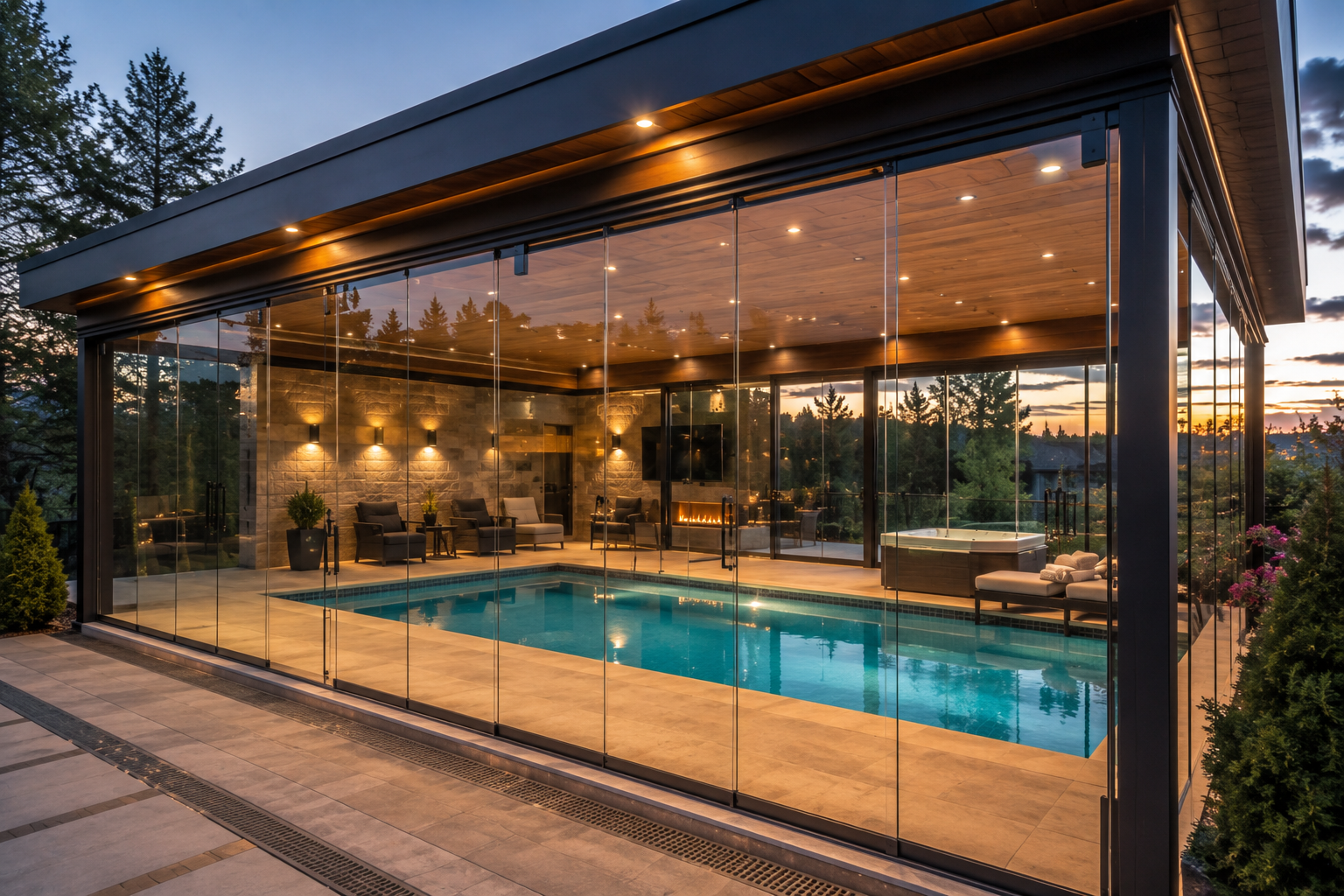
Operable panels are part of the ventilation answer, because on a warm day the enclosure opens and the moisture leaves. For cold months, mechanical ventilation or dehumidification usually has to be part of the plan. Design this in; do not retrofit it after the first condensation winter.
Chlorinated, humid air is also harder on fixings and finishes than an open-air deck installation. Hardware and finish selection for a pool should be made for that environment, and maintenance intervals are shorter. Ask us what is specified on your quote and why.
Pool barriers and City of Boulder permitting
Enclosing a pool does not remove barrier, gate and access requirements, and in some configurations the enclosure becomes part of the barrier and has to be detailed to suit. Those requirements come from the code Boulder has adopted, applied to your specific site.
The City of Boulder publishes its building permit process and residential permit guide. Confirm scope and applicability with the city for your address before the design is locked — pool work is one of the areas where it is worth doing early.
Reference: City of Boulder — building permits and inspections · City of Boulder — residential building permit guide
Snow, foothills wind and the pool deck
Boulder's downslope wind events and foothills snow both act on a pool enclosure, and the pool deck has to carry whatever structure the design needs. Structural capacity at the deck is checked at survey; where it is insufficient, that work is quoted before the glazing.
Reference: National Weather Service — Denver/Boulder forecast office
See photographs of completed Colorado installations or read who installs them.
Free Estimate
Request your free on-site estimate in Boulder
Pool Enclosures in Boulder — questions we get
Will a pool enclosure fog up in Boulder winters?
It will if the space is not ventilated. Warm water in a closed volume raises humidity and moisture condenses on the coldest surface. Ventilation or dehumidification has to be part of the design.
How much will it cut my pool heating bill?
Reducing evaporation reduces the biggest heat loss path, so heating demand generally falls — but the amount depends on your pool, set temperature, cover use and how the enclosure is run. We do not quote a percentage.
Do Boulder pool barrier rules still apply once it is enclosed?
Yes, and the enclosure may become part of the required barrier. Confirm the detail with the City of Boulder for your site before the design is finalised.
Does the enclosure open in summer?
Yes. Panels slide and stack so the pool can be fully open in July and closed again when the weather turns, which is also the simplest form of ventilation.
Pool Enclosures elsewhere
Other services in Boulder
Most useful next