Colorado · statewide
Glass pool enclosures in Colorado
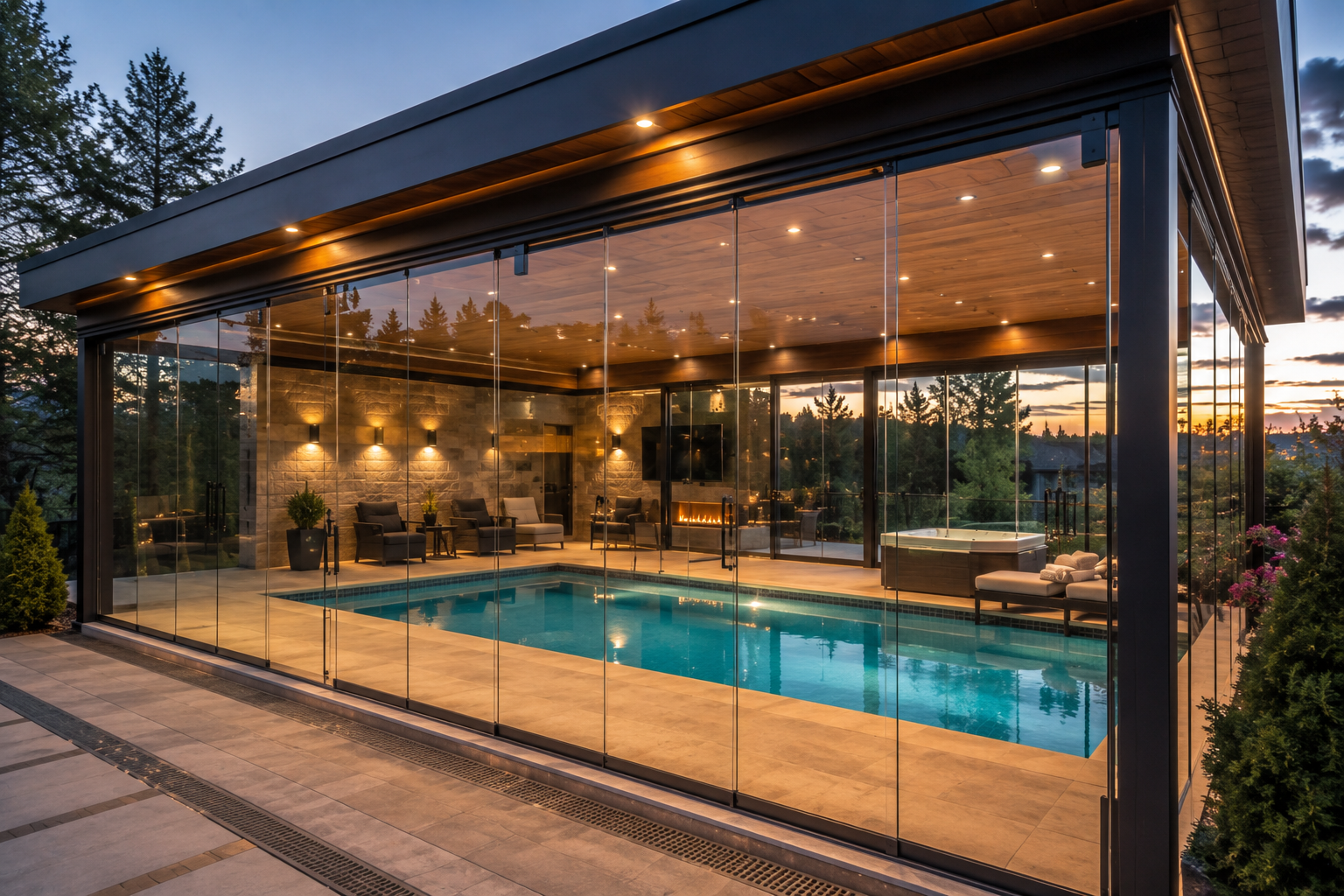
A pool enclosure is the most technically demanding thing on this list, because you are putting glass and metal around warm, chlorinated, constantly evaporating water. Get the ventilation wrong and you get condensation, corrosion and a space nobody enjoys. Most of the planning work is about moisture, not about glass.
How it works, and what it does not do
Humidity is the design problem
An enclosed pool raises the humidity of the space dramatically. Without air movement and a ventilation strategy, moisture condenses on the coldest surface — usually the glass — and then sits on hardware and on whatever the enclosure is attached to. The operable panels are part of the answer, and mechanical ventilation is often the rest of it.
Hardware specification changes near chlorine
Chlorinated, humid air is harder on fixings and finishes than open-air installations. Hardware and finish selection for a pool enclosure should be made for that environment, and the maintenance schedule is different from a deck enclosure. Ask any installer what they specify here and why.
It reduces evaporation, and evaporation is where heat goes
Covering and enclosing a heated pool cuts evaporative loss, which is the largest single heat loss path for an outdoor pool. That is the physical mechanism behind lower heating costs. The size of the saving depends on your pool, cover use, set temperature and how the space is run, so it is not a number anyone should quote you sight-unseen.
Barrier and access rules still apply
Enclosing a pool does not remove pool barrier, gate and access requirements — in some cases the enclosure becomes part of the barrier and has to be detailed accordingly. This is decided by your local building department against the code your jurisdiction has adopted, and it should be confirmed before design is finalised.
What drives the scope
- —Pool footprint plus the deck area being enclosed
- —Enclosure height and whether it is side-glazing only or a full structure
- —Ventilation and dehumidification strategy
- —Hardware and finish specification for a chlorinated environment
- —How the enclosure interacts with required pool barriers and gates
- —Supporting structure and foundations at the pool deck
- —Permitting and inspection requirements for your address
For how these translate into a budget, read what a frameless enclosure costs in Colorado.
When this is the wrong product
- ×An owner unwilling to address ventilation — glass without airflow creates a condensation problem
- ×Sites where the pool deck cannot support an enclosure structure without major work
- ×Anyone expecting a fully heated indoor pool hall from a single-glazed system
If one of these describes your project, say so at the estimate. We would rather tell you no early than sell you the wrong system.
Pool Enclosures — common questions
Will a glass pool enclosure cause condensation?
It can, if the space is not ventilated. Enclosing warm water raises humidity, and moisture will condense on the coldest surface. Ventilation and dehumidification have to be part of the plan, not an afterthought.
Does an enclosure lower pool heating costs?
Reducing evaporation reduces the largest heat loss path for an outdoor pool, so heating demand generally falls. How much depends on your pool, your set temperature, cover use and how the enclosure is operated, so we do not quote a percentage.
Do pool safety barrier requirements still apply?
Yes, and the enclosure may itself become part of the barrier. Requirements come from the code your local jurisdiction has adopted, so confirm the detail with your building department before design is locked.
See photographs of completed Colorado installations or read who installs them.
Free Estimate