Denver, Colorado · Denver Metro
Pool Enclosures in Denver
Denver's dry air is what makes a pool expensive to heat
Most Denver pool owners assume the heating bill is about air temperature. It is mostly about evaporation. Warm water sitting under dry, moving air loses heat continuously as it evaporates, and Denver's combination of low humidity, altitude and afternoon wind is close to the worst possible case for an open heated pool.
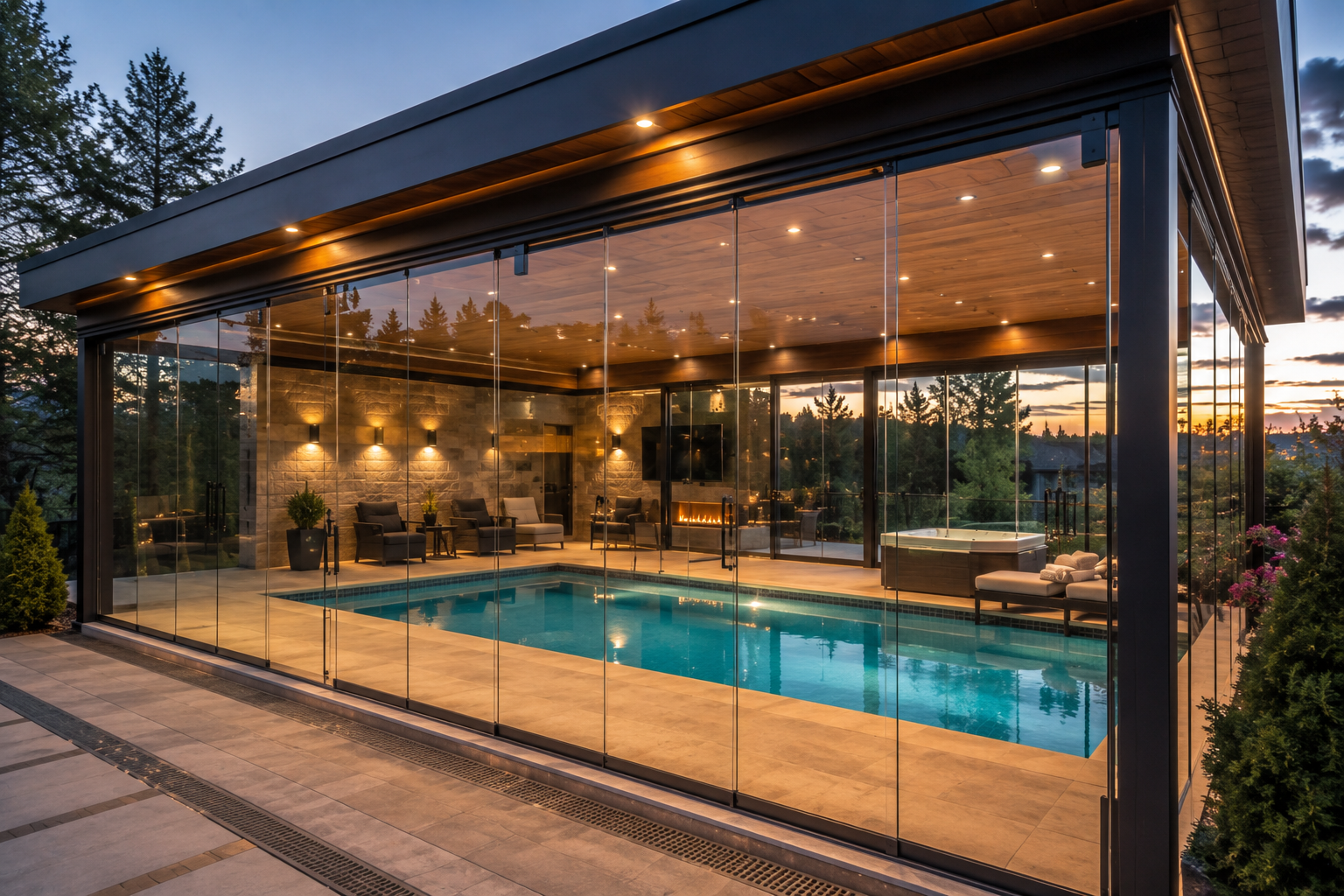
That is the physical reason an enclosure changes the economics here: cut the air movement across the water surface and you cut the dominant heat-loss path. It also happens to solve the two nuisances every Denver pool owner recognises — hail damage to everything around the water, and the constant recovery of debris after a storm.
Not sure this is the right product? Read how pool enclosures work statewide.
What enclosing actually changes, and what we will not claim
Reducing evaporation reduces heating demand, and reducing wind across the deck makes the space usable on days it currently is not. Both are real. What we will not do is publish a savings percentage, because the honest answer depends on your pool volume, your set temperature, whether you use a cover, how often the enclosure is open, and how it is ventilated. Any installer who gives you a fixed number without those inputs has guessed it.
The second real gain is season length. A Denver pool is comfortable for a narrow window; an enclosed one with heat is usable across a much wider one. Again, how much wider is a function of your heating, not of the glass.
Reference: National Weather Service — Denver/Boulder forecast office · NOAA NCEI — U.S. Climate Normals
Humidity has to go somewhere
The flip side of trapping evaporation is that the moisture now lives in your air rather than blowing away across the yard. In a closed volume above warm water, humidity climbs quickly and condenses on the coldest surface it can find — usually the glass, sometimes the structure holding it.
So ventilation is part of the design, not an afterthought. In warm months the operable panels are the answer: open the run and the moisture leaves. In cold months, when the enclosure stays closed, mechanical ventilation or dehumidification is normally required. Plan it at design stage. Retrofitting it after a winter of condensation is more expensive and considerably more annoying.
Chlorinated, humid air is also harder on fixings and finishes than an open deck installation. Hardware and finish selection should be made for that environment, and maintenance intervals are shorter than they would be on a dry deck. Ask what is specified on your quote and why.
Safety glazing and pool barriers still apply
Glazing near a pool is safety glazing territory. At federal level, architectural glazing materials are governed by the Consumer Product Safety Commission standard published in 16 CFR Part 1201, and the building code your jurisdiction has adopted layers its own hazardous-location requirements on top. Our panels are tempered; whether the specific configuration you want satisfies the requirements for your site is determined against those rules, not by us.
Separately, enclosing a pool does not remove barrier, gate and access requirements. In some configurations the enclosure becomes part of the required barrier and has to be detailed to suit. Denver publishes its adopted codes and permit process — this is one of the areas where confirming early with Community Planning & Development changes the design, so do it before anything is fabricated.
Reference: eCFR — 16 CFR Part 1201, Safety Standard for Architectural Glazing Materials · Denver — building codes, policies and guides · Denver Community Planning & Development — permits
Hail, debris and the pool deck itself
Denver's severe-storm climatology is published by NOAA's Storm Prediction Center, and any pool owner in the metro has lived the consequences: a storm passes and the water is full of leaves, grit and whatever was on the deck. A vertical enclosure will not stop hail falling from directly overhead, but it greatly reduces the wind-driven debris that causes most of the clean-up.
Finally, whatever structure carries the enclosure has to be carried by the pool deck. Deck slab condition and edge detail are checked at survey; where the deck cannot take the fixings, that work is quoted before the glazing rather than found on install day.
Reference: NOAA Storm Prediction Center — severe weather climatology
See photographs of completed Colorado installations or read who installs them.
Free Estimate
Request your free on-site estimate in Denver
Pool Enclosures in Denver — questions we get
How much will an enclosure cut my Denver pool heating bill?
Reducing evaporation reduces the largest heat-loss path, so demand generally falls — but the amount depends on your pool volume, set temperature, cover use and how the enclosure is operated. We do not publish a percentage.
Will it fog up in winter?
It will if the space is not ventilated. Warm water in a closed volume raises humidity and it condenses on the coldest surface. Ventilation or dehumidification has to be designed in for the months the enclosure stays shut.
Is the glass safe around a pool?
The panels are tempered safety glass, and architectural glazing is regulated federally under 16 CFR Part 1201 with additional hazardous-location requirements in the code your jurisdiction has adopted. Whether a given configuration complies is determined for your site.
Do Denver pool barrier requirements still apply after enclosing?
Yes, and the enclosure may become part of the barrier. Confirm the requirements and permit scope with Denver Community Planning & Development before the design is finalised.
Sources
- National Weather Service — Denver/Boulder forecast office
- NOAA NCEI — U.S. Climate Normals
- NOAA Storm Prediction Center — severe weather climatology
- eCFR — 16 CFR Part 1201, Safety Standard for Architectural Glazing Materials
- Denver — building codes, policies and guides
- Denver Community Planning & Development — permits
Pool Enclosures elsewhere
Other services in Denver
Most useful next