Colorado Springs, Colorado · El Paso County
Pool Enclosures in Colorado Springs
High, dry air makes a Springs pool evaporate faster than owners expect
Colorado Springs sits above six thousand feet in genuinely dry air, and evaporation is the largest heat-loss path for an outdoor pool. That is the physical reason a Springs pool costs what it does to heat and needs topping up as often as it does, and it is the mechanism an enclosure acts on. Reduce air movement across the surface and you reduce the loss.
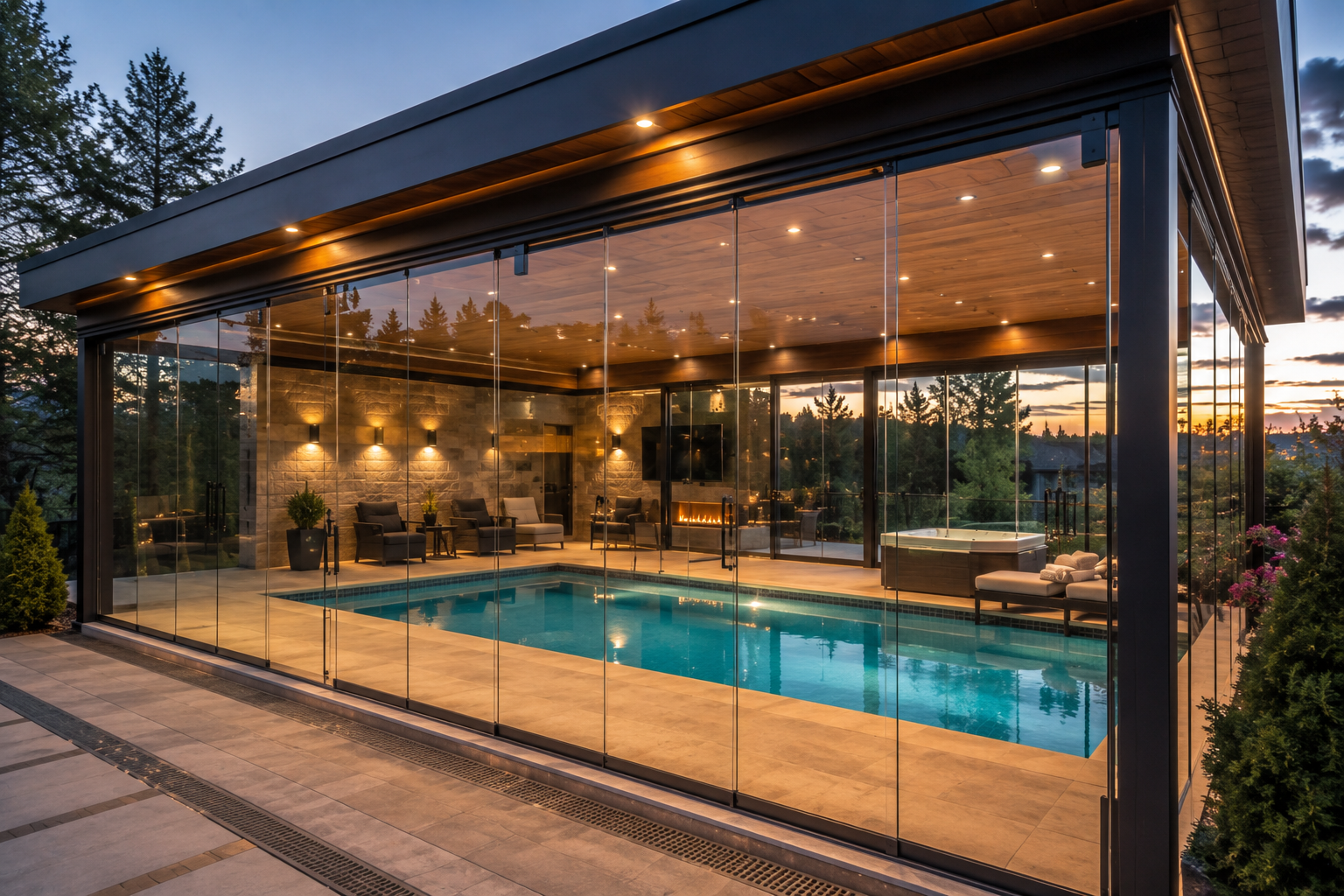
The catch is that once you enclose it, all that moisture has nowhere to go. A pool enclosure is a humidity project as much as a glass project, and most of the planning effort goes into how the space breathes rather than into what the panels look like.
Not sure this is the right product? Read how pool enclosures work statewide.
Ventilation is designed in, not added later
Enclosing warm water raises the humidity of the space dramatically, and moisture condenses on the coldest surface it can find — usually the glass, then the hardware, then whatever the enclosure is fixed to. Operable panels are part of the answer because they let you flush the space on the many mild days the Springs gets. Mechanical ventilation or dehumidification is normally the rest of it for the months the enclosure stays closed.
Hardware and finish selection changes near chlorinated, humid air as well. It is a harsher environment for fixings than an open-air deck installation, and the maintenance interval is shorter. Ask any installer what they specify for a pool environment and why; a vague answer is informative.
Hail exposure argues for planning the roof question honestly
El Paso County is in an active severe-hail corridor, as the NOAA Storm Prediction Center climatology shows, and the National Weather Service Pueblo office is the forecast office for the region. Debris and hail in the water, and damage to covers and equipment, are among the more common reasons Springs owners start looking at enclosure.
Side glazing helps reduce wind, dust and windblown debris at deck level. It does not put a roof over the water. If keeping hail out of the pool is the objective, that is an overhead structure, and an overhead structure introduces its own load, drainage and clearance questions that have to be engineered rather than assumed. We would rather set that expectation now than sell side panels against a goal they cannot meet.
Reference: NOAA Storm Prediction Center — severe weather climatology · National Weather Service — Pueblo forecast office
Barrier rules do not go away when you add glass
Pool barrier, gate and access requirements come from the code your jurisdiction has adopted, and enclosing a pool does not remove them — in some configurations the enclosure becomes part of the required barrier and has to be detailed accordingly, including how openings latch and self-close.
For the Colorado Springs region that review sits with the Pikes Peak Regional Building Department, with zoning and setback questions at the relevant planning office. Get the barrier interpretation before the layout is fixed, because it can move panel positions and door locations, and moving them after fabrication is expensive.
Reference: Pikes Peak Regional Building Department · City of Colorado Springs — Planning & Neighborhood Services
What the enclosure will and will not do for heating
Cutting evaporation reduces the biggest single heat loss, so heating demand generally falls and the usable season lengthens at both ends. How much depends on your pool volume, set temperature, cover discipline, ventilation strategy and how often the enclosure is left open. We do not quote a percentage, because a percentage without those inputs is a guess dressed up as a number.
And a single-glazed frameless enclosure is a weather envelope around a heated pool, not an insulated pool hall. If your requirement is a genuinely conditioned indoor pool room, that is a building project with an insulated envelope and mechanical plant, and we will tell you so at the estimate.
See photographs of completed Colorado installations or read who installs them.
Free Estimate
Request your free on-site estimate in Colorado Springs
Pool Enclosures in Colorado Springs — questions we get
Will a glass enclosure keep hail out of the pool?
Side glazing will not — it helps reduce wind and windblown debris, but the water is still open to the sky. Keeping hail out means an overhead structure, which carries its own load, drainage and clearance engineering. That is a different scope and we will price it as one rather than implying side panels achieve it.
How bad is condensation in an enclosed pool here?
It is entirely a function of ventilation. The dry outside air actually helps when you can flush the space, but on cold days with the enclosure closed, moisture will condense on the glass and hardware unless mechanical ventilation or dehumidification is part of the design. Treat it as a requirement, not an upgrade.
Do pool safety barrier requirements still apply after enclosing?
Yes, and the enclosure may become part of the required barrier. The interpretation for your site comes from the reviewing authority — in this region, Pikes Peak Regional Building Department — against the adopted code. Confirm it before the layout is finalised, because it affects panel and door positions.
Will we be able to swim in January?
The season lengthens significantly and the Springs gets a lot of winter sun, but comfort in deep winter is a function of your heating and ventilation design rather than of the glass. A single-glazed frameless system is a weather envelope, not an insulated building, and we will not pretend otherwise.
Pool Enclosures elsewhere
Other services in Colorado Springs
Most useful next